Aligned Isn't Proof: Curriculum Mapping, Standards-Based Reporting, and the Bridge to the Classroom
"Aligned" is the most common word on a curriculum sales sheet. Districts see the correlations, and they value them. But correlations alone have never really been enough. It's a "yes, and" moment: yes, show us the alignment, and show us the proof.
That's because "aligned" says nothing about how. It doesn't tell a district how a standard is approached, introduced, taught, practiced, or assessed. A standard can be aligned on paper and barely taught in practice. And alignment isn't something a third party should layer on after the fact. It's core data, developed alongside the curriculum as each lesson, activity, and assessment is written.
A standard can be aligned on paper and barely taught in practice.
Ask a publisher why a district passed on their program, and you might hear about price or timing. Read the district's own notes, and a different reason shows up again and again. The publisher provided a correlation document, but the reviewer couldn't search the materials by standard in the system itself, and there were no reports showing how students were doing against the standards. The alignment lived on paper, not where the district needed it. The evidence wasn't there, so the product failed to bridge to the district.
That gap is what this piece is about. At the backbone of everything we've built at C2C are two things: curriculum mapping and standards-based reporting. One leads directly to the other. Together, they're the bridge from a publisher's materials to a district's classrooms.
Where this started: NCLB and the publisher's data problem
In brief: NCLB turned standards into the measuring stick for everything, and correlation spreadsheets couldn't keep up. Standards had to become data, built into the curriculum itself.
This argument didn't come from a product roadmap. It started 21 years ago, when I joined Pearson's newly formed Curriculum Alignment Department in 2005.
It was the height of No Child Left Behind. The law required every state to set academic standards and to test students against them every year in reading and math, in grades 3 through 8 and once in high school, with science testing soon to follow. Results were public, and schools were held accountable for them. Standards stopped being a reference document on a shelf. They became the measuring stick for everything.
That put publishers in a real data management pickle. There was no common set of standards. Every state wrote its own, for every subject and every grade, and revised them on its own schedule. A single national program might need to show alignment to fifty different frameworks, each organized differently, each worded differently, each changing at a different time.
Most publishers handled it the only way they could: correlation documents. Spreadsheets and binders mapped page numbers to standard codes, state by state. They were slow to build, expensive to maintain, and out of date the moment a state revised its standards or an editor revised a lesson. And they lived apart from the curriculum itself, so nobody could see how a standard was actually being taught.
Our department's job was to audit Pearson programs against all of this. We weren't just checking whether a standard appeared. We were checking how it was introduced, taught, practiced, reviewed, and assessed, because that's what adoption states like Texas demanded as evidence.
We weren't always the people an editorial team wanted to see coming down the hall. Our audits exposed where a program wasn't quite meeting the mark: a standard that was claimed but only mentioned, a skill that was assessed but never really taught. Those conversations weren't always comfortable. But it was far better for subject departments to find the gap inside, from us, before the state's adoption committee did.
The audits also exposed a structural problem. A standard defines what students should learn, not how they get there. The how is the substance of a curriculum, yet it lived in correlation spreadsheets that served as a proof point at adoption and little else. Teachers couldn't use them to plan instruction, and districts couldn't use them to monitor progress.
The implicit promise was a kind of transitive property: the program is aligned to the standards, so if you use the program, you'll cover the standards. But that isn't how programs are used. Teachers skip lessons, reorder units, and run out of time. Once a program is used out of order or only in part, the correlation no longer describes what students actually received. The how needed to be captured as data and built into the curriculum from the start, where publishers could prove it and teachers and districts could use it.
A standard defines what students should learn, not how they get there.
That principle shaped the next two decades of my work. In 2009, I joined Curriculum Associates as a founding team member of i-Ready, a program designed from the start to connect instruction, assessment, and reporting. In 2012, I co-founded EvoText to help large publishers build, deliver, and manage their digital programs. In every engagement, our first recommendation was the same: invest in standards-based reporting.
Those systems worked. But they were built for publishers with enterprise budgets, and most of the publishers making great curriculum couldn't afford anything like them. So in 2019, EvoText built Content2Classroom, to give every publisher the infrastructure the largest ones had built for themselves. C2C exists for one reason: access. Every publisher with strong curriculum deserves the infrastructure to prove it. And access runs both ways: every district deserves the best curriculum available, with the evidence to back it, no matter the size of the company that wrote it.
That's the story behind C2C. Everything that follows, from how we dissect standards to how we report on them, grew out of solving that pickle for good.
Access runs both ways. Every publisher with strong curriculum deserves the infrastructure to prove it. Every district deserves the best curriculum, no matter who publishes it.
Why it matters even more now
In brief: When districts cut programs, missing standards evidence is one of the fastest ways to get dropped.
Twenty years later, the pickle hasn't gone away. It's gotten more expensive to ignore.
Federal pandemic relief funds have run out, and districts are trimming their product lists. Every renewal gets a harder look. At the same time, a growing backlash against classroom technology has districts asking whether each digital program earns its place in front of students. States are tightening reviews too. Texas, for one, has always reviewed instructional materials, and it has raised the bar further with a more rigorous quality review layered on top of its traditional adoption process.
I recently sat next to a district chief information officer who told me how his district had cut roughly 2,000 edtech products down to about 200. There was no long deliberation over each one. His team ran every product through two screens: does it meet our academic requirements, and does it meet our technical requirements? Anything that failed either screen was out.
That's 1,800 products gone, and surely some of them were good curriculum. They weren't necessarily cut because teachers disliked them. They were cut because they couldn't show the district what it needed to see.
When a district is cutting, it looks for clear reasons to keep a program and clear reasons to drop one. Missing standards evidence is one of the easiest reasons to drop, right up there with failing to meet the district's technical requirements. If a curriculum director can't show the board how a program covers the standards and what students did with it, that program is an easy line to cross off. Programs with that evidence in hand make the case for themselves.
They weren't necessarily cut because teachers disliked them. They were cut because they couldn't show the district what it needed to see.
"Standards" means more than state standards
In brief: A standard is any framework you've promised to teach, and how those standards are organized matters as much as which ones you load.
When most people hear "standards," they think of a state framework: TEKS, the Florida B.E.S.T. standards, NGSS, Common Core. Those matter. But for a curriculum publisher, a standard is any framework you've promised to teach.
That includes state and national standards. It also includes industry and trade standards, certification body learning objectives, durable or 21st-century skills, and the publisher's own skill spine, the progression your program was designed around.
A high school engineering course might need to report against NGSS, a state CTE framework, and an industry certification, all at once. A literacy program might want its own skills sequence to sit right next to the state standards, so a district can see how the two line up. These aren't edge cases. They're how good curriculum actually gets built.
So the first test of any approach to alignment is simple. Can you bring in whatever framework you need, manage it yourself, and report against it? If the answer is "only the ones a vendor has already loaded," the system is deciding what your curriculum is allowed to be accountable for.
And it isn't only which standards are loaded. It's how they're loaded. The organization of a standard set matters a great deal. A flat list of codes, in the order a state happened to publish them, tells a district very little about how your curriculum actually works.
It's perfectly fine, and often necessary, to present the same standards in more than one way. One organization might follow your order of instruction. Another might group standards by their weight on the end-of-course assessment. A third might pair state standards with your own skill progression. Each view answers a different question a district is asking. Together, they make sure every dimension of a standard is covered and visible.
Built on curriculum mapping
In brief: Teachers bundle standards; districts need them reported one at a time. C2C was built on curriculum mapping so you never have to choose.
C2C's architecture didn't start with software. It started with curriculum mapping, and with the work of Heidi Hayes Jacobs and Marie Alcock.
Jacobs reshaped how schools think about curriculum with Mapping the Big Picture: Integrating Curriculum and Assessment K–12, and her mapping model is used by schools around the world. With Alcock, she pushed the thinking forward in Bold Moves for Schools (ASCD, 2017), challenging educators to move from antiquated practice to contemporary learning. Her core idea is simple and still radical: "Mapping is a verb." A curriculum map isn't a static document filed for compliance. It's a living record of what is actually taught, how, and how it is assessed, revisited and improved over time.
That idea resonates even more today, because real teaching bundles standards. A good unit doesn't march through standards one at a time. A single engineering challenge can integrate science practices, math, and communication skills at once. Teachers bundle standards because that's how students learn best.
The problem is that most systems force a choice. Either you document the curriculum the way it's taught, bundled and integrated, or you document it the way it's reported, one standard at a time. You can't easily have both.
We built C2C so you never have to choose. Its architecture follows the mapping tradition: content, skills, standards, and assessments are mapped together, as they're actually taught. Standards can be bundled into lessons and units the way teachers use them, and still be unbundled, tagged, and reported one part at a time. The same map that documents alignment also produces the evidence of student performance and usage. It's the flexibility Jacobs and Alcock described, built into the backbone of the system.
In C2C, standards are never bolted on later. They're load-bearing from the start, built into the frame of the curriculum you create from the very first lesson. Build the curriculum, and the structure that proves it is already there.
For publishers, that means you design curriculum the way great teachers teach, and you can still prove it to districts, standard by standard.
Standards are never bolted on later. They're load-bearing from the start.
How curriculum mapping actually works
In brief: Pull standards apart, tag each part to where and how it's taught, and the data stays honest.
Standards are not written one-to-one. Most are compound, with several distinct expectations packed into one sentence. Content isn't one-to-one either. A single lab can touch three standards, and a single standard can take a unit to cover.
If you tag a whole activity to a whole standard, you overstate what the activity did. The report says "standard covered." The truth is "one part of it, once." Districts notice.
The fix is to pull standards apart before you map to them.
State adoptions still demand evidence of how each standard is taught, not just that it appears. A program that merely mentions a standard doesn't hold up. The evidence has to be mapped to each point where a standard is taught, and your reporting should mirror that same structure.
That's how C2C works. Take a middle school engineering standard, NGSS MS-ETS1-1:
Define the criteria and constraints of a design problem with sufficient precision to ensure a successful solution, taking into account relevant scientific principles and potential impacts on people and the natural environment that may limit possible solutions.
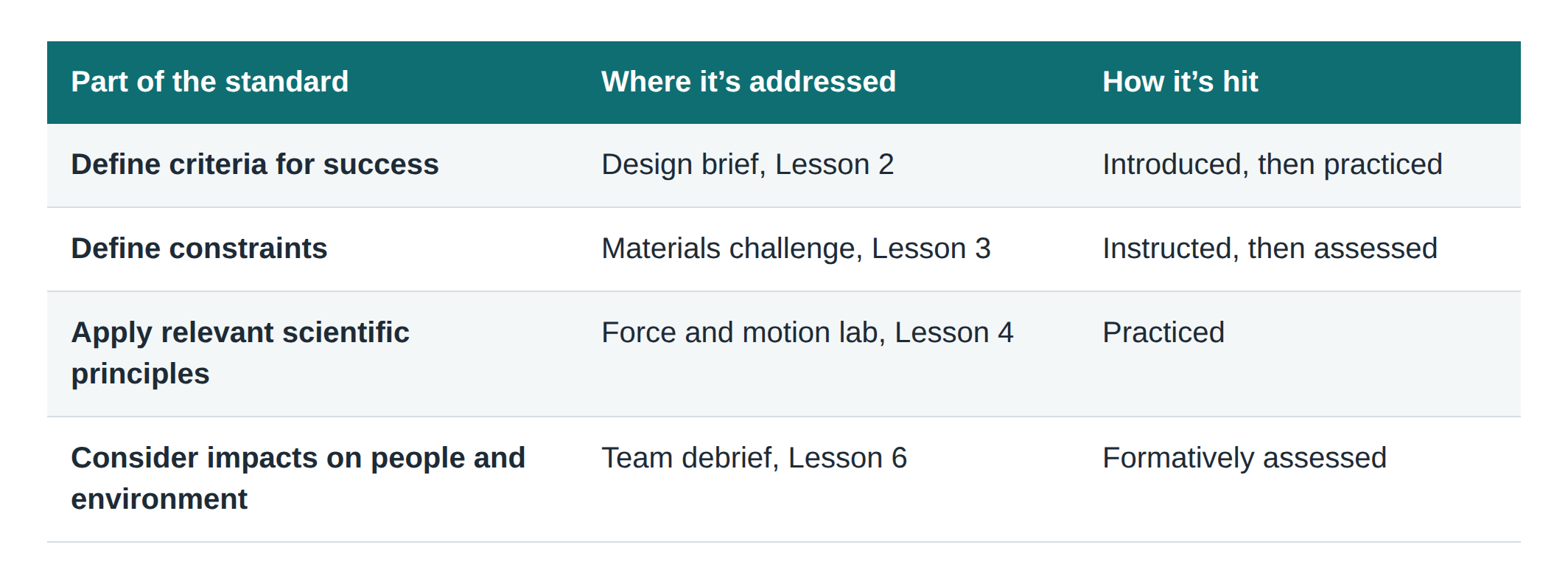
That's at least four expectations. Pulled apart and mapped, it might look like this:
Standard Expectations
Two things happen in that table. First, each item is tied to the specific part of the standard it addresses, not the whole thing. Second, each tag records how the standard was hit: introduced, instructed, practiced, reviewed, or assessed. That's the same evidence a state reviewer looks for, and the reporting can show it student by student.
You can add more dimensions as needed, such as weights or a second framework on the same item. That's what makes the data honest later.
Alignment is editorial judgment about your own materials, and your team knows what each activity is really doing better than anyone. That's why it doesn't belong with a third-party service. In C2C, everything your team needs to do the work is built in. When the materials change, the mapping changes with them, and the reporting follows automatically.
Curriculum frameworks in C2C
In brief: Ingest, dissect, bundle, tag, report. One set of tags, viewed along any dimension a district needs.
In C2C, all of this happens inside curriculum frameworks. A framework is where your standards live, and where they're shaped to match the way your curriculum is actually taught and assessed.
Working with a framework follows the same path every time:
Ingest. Bring in any standard set: state, national, industry, certification, durable skills, or your own skill spine.
Dissect. Parse each standard into its component parts, so every expectation inside a compound standard can be addressed on its own.
Bundle. Reorganize the parts into the sets that matter for your program, such as units, a scope and sequence, or an assessment blueprint.
Tag. Attach the dimensions that describe how each standard is treated.
Report. Every tag flows into standards-based reporting on performance and usage.
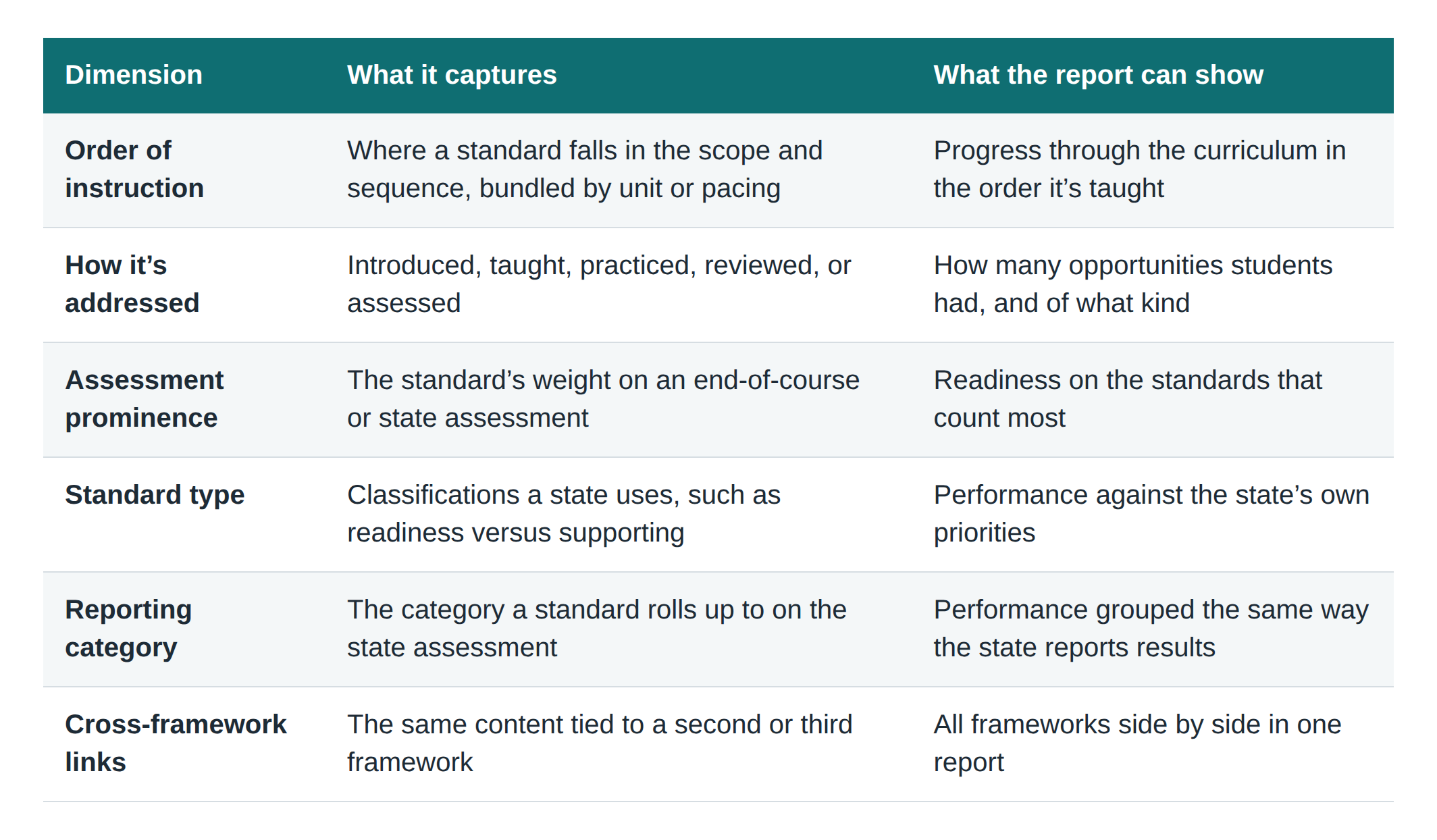
The tags are what let a single standard be seen through several lenses at once. A few examples:
Framework Dimensions
Because the bundles are yours to define, the same standards can be arranged one way to show order of instruction and another way to show what matters most on the end-of-course test. Nothing is duplicated. The underlying tags stay the same, and the reporting simply rolls them up along whichever dimension a district needs to see. A district sees exactly what each part of a standard covered, then the full standard rolled back up, including how and how many times it was taught.
Mapping is what makes reporting possible
In brief: Careful mapping turns every student interaction, on screen or teacher-led, into evidence of performance and usage.
Good standards-based reporting isn't a dashboard you bolt on at the end. It's what careful mapping produces automatically. If every item is tagged to the specific part of a standard, and to how it was taught, every student interaction becomes evidence.
That evidence answers two questions districts always ask.
Performance. How are students doing on each standard, and on each part of it? Where is a class strong, and where does it need reteaching?
Usage. How long was each student actually exposed to each standard, in how many different ways, and with how many chances to show what they know? A low score means something different when students saw a standard once than when they practiced it six times in multiple modalities.
Because the mapping lives at the item level, the same data rolls up cleanly from student to classroom, school, and district. It can also feed whatever data systems a district already uses.
Multiple frameworks work the same way. If a course is tagged to a state standard, an industry certification, and a set of durable skills, all three appear together in one report. A district sees the course from every angle it cares about, without a separate correlation document for each.
This also works in hands-on, teacher-led classrooms. Not every lesson should put students in front of a screen, especially in the early grades. When a teacher leads instruction from the front of the room, that instruction can still be recorded as taught, aligned to standards, and credited to the students present. Teachers can log observations. Quick checks and formal assessments flow into the same reports as everything else. The classroom stays hands-on, and the evidence still counts.
The bridge to the classroom
In brief: Districts buy on evidence they can inspect and renew on results they can see in their own data. Standards-based reporting delivers both.
Publishers and districts often talk past each other. Publishers describe what their curriculum is designed to do. Districts need to see what it is doing, in their classrooms, against their standards.
Standards-based reporting is the bridge between those two conversations. It matters most at the two moments when a district decides to buy.
The first is adoption. Before a district commits, reviewers want evidence they can inspect for themselves. They want materials they can search by standard, and a clear picture of how each standard is taught. A correlation document asks them to take your word for it. Mapped curriculum lets them see it. (I've written separately about what districts are really asking for when they evaluate standards alignment.)
The second is renewal, and it decides whether a program lasts. By then, the district isn't evaluating your design. It's evaluating results in its own classrooms. A curriculum director defending a renewal to a school board doesn't want a study from someone else's district. They want their own students' data, standard by standard: where performance grew, where students got the most instruction, and where the program delivered.
Picture a curriculum director in March, a few weeks before the board votes on next year's budget. Every program is on the table. She opens one report. It shows which standards her students have mastered and where they're still developing. It shows how much instruction they actually received on each standard, and in how many ways, including the hands-on lessons her teachers led at the front of the room. It shows usage by school, so she knows the program is being taught, not just licensed. She walks into the board meeting with evidence, not a vendor's promise. That program stays.
Now picture the program sitting next to it on the list, with nothing to show but a correlation document. That's the one that gets cut.
Standards-based reporting produces that evidence as a natural byproduct of teaching with the curriculum. A principal can see where support is needed. A teacher can decide what to reteach on Monday. And when renewal comes, the publisher isn't arguing for its program. It's confirming what the district can already see in its own data.
That's why I describe C2C as a bridge more than a piece of software. You sell curriculum. You renew with results. The publishers who lean into standards-based reporting, showing districts exactly how their standards are treated, bundled, and taught, see it in their renewals.
This used to be something only the largest publishers could afford to build. It shouldn't be. Every publisher with strong materials deserves to show districts the same proof.
You sell curriculum. You renew with results.
Questions to ask about your own alignment
If you're a publisher, here's a quick test of whether your alignment is a claim or proof.
Can a district reviewer search your materials by standard, in the product itself?
Are your standards pulled apart, or is each activity tagged to a whole standard?
Do your tags record how a standard was addressed, or only that it was?
Can you add and manage your own frameworks, such as certification standards, durable skills, or your own skill spine?
Can a district see performance and usage by standard, from the student up to the district?
Does teacher-led, hands-on instruction show up in that reporting, or only what students do on screens?
If any answer is no, that's the gap districts are telling you about. Close it, and "aligned" stops being a word on a sales sheet. It becomes the reason they renew.
See your standards as data
This isn't theory. Curriculum built and delivered with C2C has served more than 10 million students, in classrooms across all 50 states and in 20 of the 25 largest U.S. school districts. C2C has earned CODiE Awards for Best Authoring Solution and Best Formative Assessment Solution, and C2C TestBuilder powered a publisher's Best Summative Assessment Solution win.
If you want to see what this looks like for your own curriculum, send us one unit. We'll bring in your standards, pull them apart, map them to your materials, and show you the reporting a district would see. It's the fastest way to find out whether your alignment is a claim or proof.
Johanna Wetmore, Ed.D., is the Co-Founder and CEO of Content2Classroom, the CODiE Award–winning infrastructure behind digital curriculum for more than 10 million students. In 20+ years in educational publishing, she audited programs in Pearson's Curriculum Alignment Department, helped launch i-Ready at Curriculum Associates, and co-founded EvoText to build enterprise educational technology and curriculum development systems.